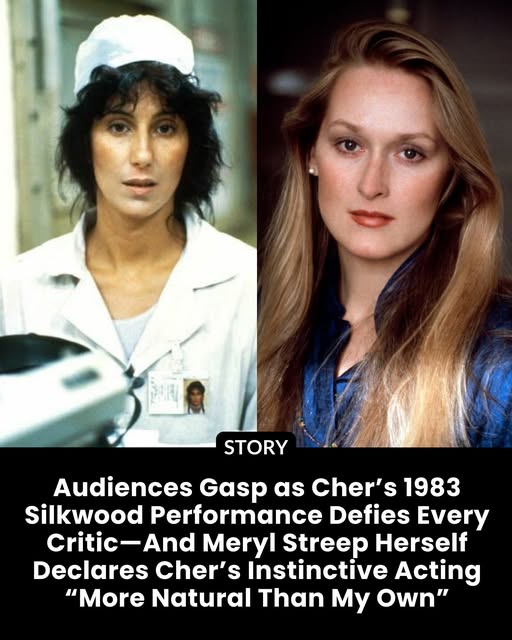
In the early 1980s, when Cher declared her intention to transition into a serious film actress, Hollywood responded with widespread mockery. Critics and directors dismissed her as a mere “fair singer,” known primarily for her revealing costumes and flamboyant television personality. The sarcasm reached a fever pitch when it was announced that she would co-star alongside Meryl Streep, then already recognized as one of cinema’s greatest talents, in the drama Silkwood. Public opinion predicted that Cher would be utterly “swallowed up” by Streep’s technique and reduced to a laughingstock next to such undisputed class.
Cher’s response to this cynical dismissal was a radical shedding of her superstar facade. For her role, she accepted a supporting part as Dolly Pelliker, a gay nuclear power plant worker, and embraced complete transformation. She went entirely bare-faced, forgoing her signature makeup and glamorous attire for simple, casual clothes. Instead of relying on ostentatious acting techniques, she delivered her performance with raw, gut-level instinct and honesty. Her portrayal was so natural and emotionally poignant that audiences quickly forgot they were watching the pop superstar Cher, seeing only the fully realized character of Dolly Pelliker.
The result was stunning, defying all expectations. Meryl Streep, the actress everyone assumed would eclipse her, became Cher’s most ardent supporter. Streep openly admitted that while she herself had to meticulously study and apply acting techniques, Cher simply “walked in and acted like she breathed,” recognizing the genius of Cher’s instinctive approach. This profound validation from Meryl Streep proved pivotal, paving the way for Cher to receive an Academy Award nomination for Silkwood that year, and ultimately securing her status as a double Queen of both Music and Film when she later won the Oscar for Best Actress for Moonstruck.