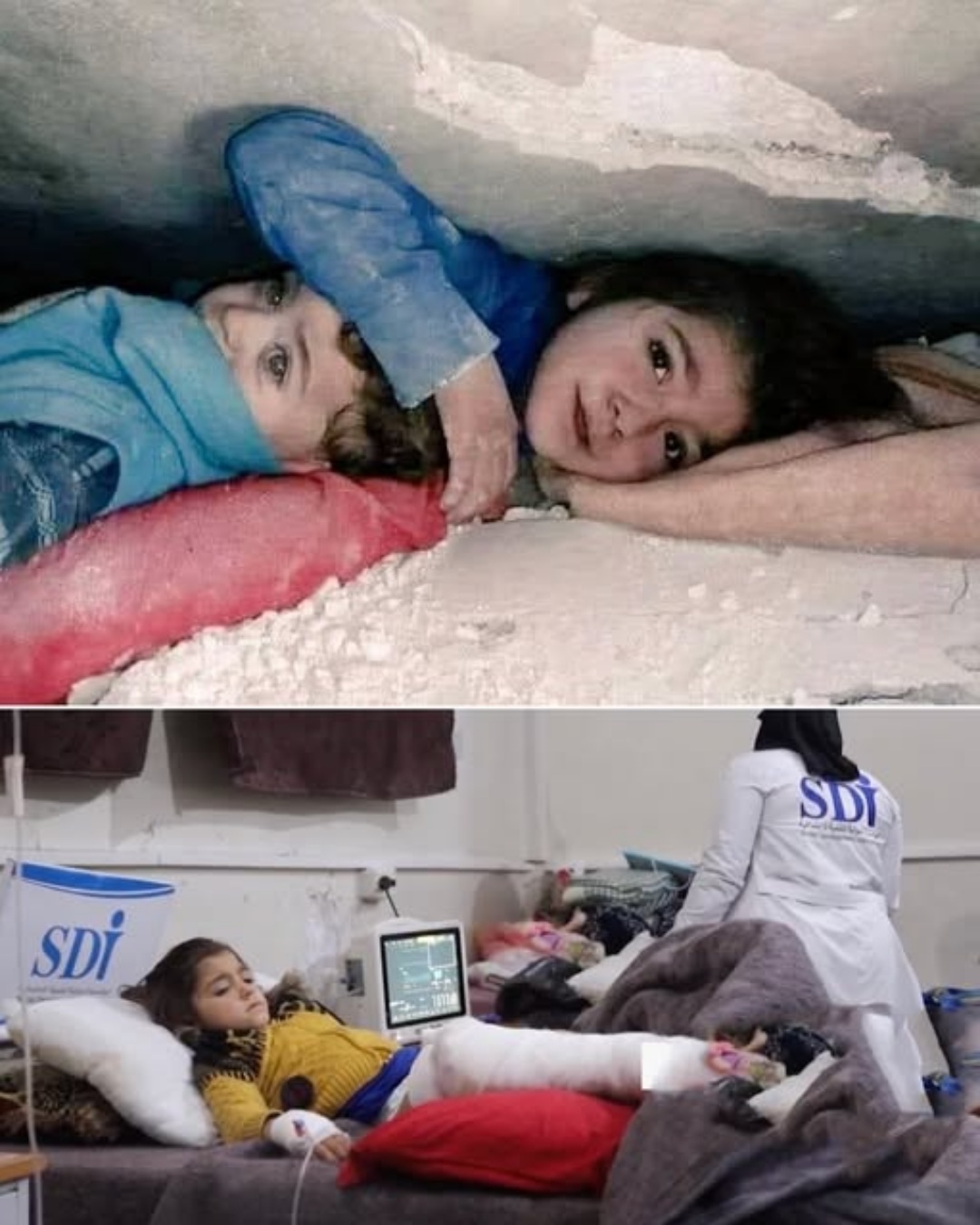
In the aftermath of one of the most devastating earthquakes to strike Syria, stories of heroism and resilience emerged from the rubble. Among them was the extraordinary tale of Gwendolyn, a seven-year-old girl whose courage, love, and selflessness captured the hearts of everyone who heard her story. Trapped beneath collapsed buildings, surrounded by the dust and debris of destruction, Gwendolyn faced pain and fear that would overwhelm even the bravest adults. Yet her first thought, even in the midst of her own suffering, was not for herself—it was for her younger brother, equally frightened and crying beside her.
The earthquake had struck without warning. Buildings crumbled, the ground shook violently, and entire neighborhoods were reduced to piles of stone and dust. In the chaos, Gwendolyn found herself pinned under debris, unable to move freely. The weight pressing against her body caused sharp, excruciating pain. Broken bones and bruises made every movement agony. Yet amid this unimaginable scenario, her focus remained steadfast. Her little brother, terrified and panicked, clung to her arm. His sobs and cries could have broken anyone’s heart, and Gwendolyn understood that he needed her more than she needed help for herself at that moment.
For seventeen hours, Gwendolyn became his protector. She whispered comforting words, sang lullabies, and told stories to distract him from the destruction around them. Every word was a lifeline; every gesture a shield against the chaos of collapsing walls and the deafening roar of the quake’s aftermath. Despite her injuries and the pain radiating through her body, Gwendolyn’s focus never wavered. She understood, in a way far beyond her age, that courage is not the absence of fear but the ability to act in the face of it.
Her resourcefulness during those hours was remarkable. Using the small space she had under the rubble, she shifted pieces of debris carefully to create some semblance of shelter for her brother, ensuring he remained as safe as possible. She improvised, using clothing and other items within reach to cushion and protect them both. Her actions were guided not by training or instruction, but by pure instinct, compassion, and the fierce bond between siblings.
Rescue teams, alerted to trapped civilians, worked tirelessly to locate survivors. When Gwendolyn and her brother were finally discovered, the scene that unfolded was extraordinary. Despite her own injuries, Gwendolyn’s first words were not pleas for assistance or cries of pain. Instead, she looked toward her rescuers and said, “Take him first.” Even in the face of her own suffering, her priority remained the safety of her younger brother. The selflessness displayed by a seven-year-old in such dire circumstances left all who witnessed it profoundly moved.
Medical personnel quickly assessed their condition. Gwendolyn’s body bore the marks of the long ordeal—bruising, broken bones, and exhaustion—but her spirit remained unbroken. Her brother, comforted by her constant attention and courage, was physically shaken but emotionally soothed by the protective presence that had sustained him through seventeen hours of terror. The bond between them, forged in extreme adversity, had become a source of survival.
The news of Gwendolyn’s bravery spread rapidly. In the aftermath of the earthquake, amidst the despair, her story became a beacon of hope. Media outlets, humanitarian organizations, and social networks shared her tale of selflessness, resilience, and love. People around the world were inspired by the image of a small child prioritizing the life of another, demonstrating that courage and compassion can shine even in the darkest moments.
Psychologists and child development experts were quick to highlight the remarkable nature of her response. For a child of seven, understanding the needs of another and acting with such focused selflessness is extraordinary. Gwendolyn’s actions exemplified innate empathy and moral courage, showing that even in situations of extreme trauma, the human capacity for love and protective instinct can prevail. Her story challenged conventional notions of vulnerability, illustrating that bravery is not limited by age or physical stature.
For her family, Gwendolyn’s survival and protective instinct became a profound source of pride. They witnessed firsthand the depth of her love, her extraordinary resilience, and her determination to preserve life despite her own suffering. In interviews, her parents described a mixture of awe, relief, and gratitude. They recognized that the same fear that would immobilize adults had been met by their daughter with remarkable clarity and courage.
Humanitarian workers noted that stories like Gwendolyn’s were critical in sustaining morale for survivors in the earthquake’s aftermath. Her tale reminded people that even amid widespread devastation, acts of heroism and compassion can emerge, providing emotional uplift and encouraging collective resilience. Communities, shaken by loss, drew inspiration from her courage, finding in her actions a symbol of hope, unity, and perseveranc
In the days following the rescue, Gwendolyn received urgent medical care to address her injuries and the physical toll of being trapped. Her recovery, while challenging, was bolstered by her unwavering spirit. Even in the hospital, she continued to demonstrate her protective and empathetic nature, often comforting other children who were experiencing fear and pain. Her experience became not only a story of survival but also a lesson in empathy, courage, and the profound impact that one person—no matter their age—can have in life-and-death circumstances.
Gwendolyn’s bravery also emphasizes the importance of the sibling bond in survival scenarios. Research has shown that in high-stress environments, strong familial connections can serve as emotional anchors, enhancing resilience and fostering adaptive responses. Gwendolyn’s instinctive prioritization of her brother’s safety exemplified this principle, illustrating how love and responsibility can inspire extraordinary acts even in the youngest individuals.
As the world heard of her story, many organizations leveraged her courage to advocate for increased aid and support for children affected by natural disasters. Her story became a symbol of resilience and moral strength, reminding the global community that even in the darkest times, hope and compassion endure. Charities, schools, and media outlets shared her example to teach lessons of bravery, empathy, and the power of selflessness.
Gwendolyn’s story ultimately transcends the specifics of the earthquake itself. It is a narrative about the enduring potential of the human heart, the capacity to act selflessly, and the ability to shine light in places overshadowed by devastation. She reminds us that courage is not the absence of fear but the choice to protect, to comfort, and to uphold love when it matters most.
Her actions continue to inspire survivors, rescuers, and communities worldwide. They serve as a poignant reminder that heroism does not require grandeur or recognition—sometimes it emerges in the quiet, steadfast protection offered by a child to a sibling. Gwendolyn’s seventeen-hour vigil beneath rubble demonstrates the extraordinary impact of small hearts committed to others, proving that even in despair, love can illuminate the path to survival.
In the end, Gwendolyn stands as a symbol of hope, love, and resilience. Her courage teaches that even the smallest hearts can shine the brightest, that selflessness can sustain life, and that in moments of catastrophe, compassion and bravery are the most powerful forces of all. Her story will remain a beacon, reminding the world that true strength is measured not only in physical survival but in the depth of one’s heart and the love one shows to others.